


In a recent article on AL JAZEERA, Martin Griffiths acknowledges the international community’s failure in Syria, only to advance an approach that risks repeating it. After humanitarian aid displaced political transition, investment is now being cast as its practical substitute—a course that may deliver little more than fragile stability.
There is nothing wrong with Griffiths calling for Syria’s economy to be rescued, the remaining sanctions to be lifted, and Syrian and international capital to help finance reconstruction. A country emerging from a devastating war, with most of its population living in poverty, cannot build a durable peace on a ruined economy. What is striking is that such a reductive prescription should come from Griffiths of all people.
This is not an economist observing Syria from afar. It is a man who has spent decades in diplomacy, mediation and humanitarian work; who worked on Syria from the early years of the conflict; who met Bashar al-Assad and senior regime officials; and who witnessed at close range the complexity of the war, the limits of mediation, the failures of the United Nations and the tangled web of regional and international intervention.
Griffiths knows that Syria did not simply suffer an economic crisis made worse by war. It suffered a crisis of statehood and legitimacy, rooted in the relationship between power and society, which escalated into armed conflict and then into several overlapping conflicts. He knows that the fall of the regime does not automatically answer the questions that drove the country to breaking point: Who owns the state? Who constrains power? How is authority constituted? And where do Syrians, in all their diversity, fit within the political order? Yet in his article, he treats the end of the war in its previous form as a definitive transition to peace. He makes rebuilding the economy the overriding priority.
That is not a conclusion dictated by the facts. It is a choice about how the problem is defined. Once Syria is framed primarily as a shattered economy and a high-risk investment climate, the prescribed solutions follow: lift sanctions, pass legislation, mitigate risk and improve the government’s ability to honor its commitments. Political legitimacy, judicial independence, transitional justice, the missing and detained, property rights and Syrians’ participation in rebuilding their state all recede from view, not because they have been resolved, but because this lens renders them peripheral.
Military action ended the regime. It did not save Syria
Griffiths acknowledges that international diplomacy failed to move al-Assad and describes the decision to rule out regime change from the outset as the international community’s “original sin”. It is an important admission, but he draws from it a conclusion that deserves scrutiny: that Syrians were saved by military action and that the takeover of Damascus opened the way to peace.
Military action ended al-Assad’s rule, removed one of the principal drivers of the catastrophe and created a historic opening for the country. But military victory can topple a regime; it cannot, by itself, produce a social contract. It can open the way to peace, but it is not peace. The fall of the regime removed a central obstacle without determining the shape of the state that follows or the relationship between those who govern and those who are governed.
Nor was the international community wrong to worry about the survival of the Syrian state. Preserving the state, its institutions and the interests of its citizens was—and remains—a national necessity. The error was to conflate the state with the regime, then use the legitimate fear of institutional collapse to block political change and protect the existing power structure. Opportunities for transition were foreclosed when the cost might have been lower. The conflict dragged on until the regime was ultimately overthrown by force, by which time the price of change had soared and much of the very state and society that this policy purported to protect had been destroyed.
A managed stalemate
The international failure went beyond ruling out regime change. The states involved in Syria operated on two levels that appeared contradictory but proved complementary in practice. They treated the regime’s collapse as a greater danger than the continuation of the conflict—especially after the rise of ISIS—while simultaneously arming and financing the opposition through military operations centers ( MOM- MOC) in Turkey and Jordan.
The result was a managed stalemate: enough support to keep the fighting going and prevent particular actors from being defeated, but not enough to force a settlement or transform the structure of power; enough diplomatic pressure to keep negotiations notionally alive, but no process capable of producing an actual transition. Over time, the priority shifted from addressing the causes of the conflict to organizing the disorder it produced: disciplining factions, demarcating spheres of influence, freezing front lines, and confining armed groups and civilian populations to separate enclaves. International policy contained the chaos instead of dismantling its causes.
From a safe environment for transition to safe passage for aid
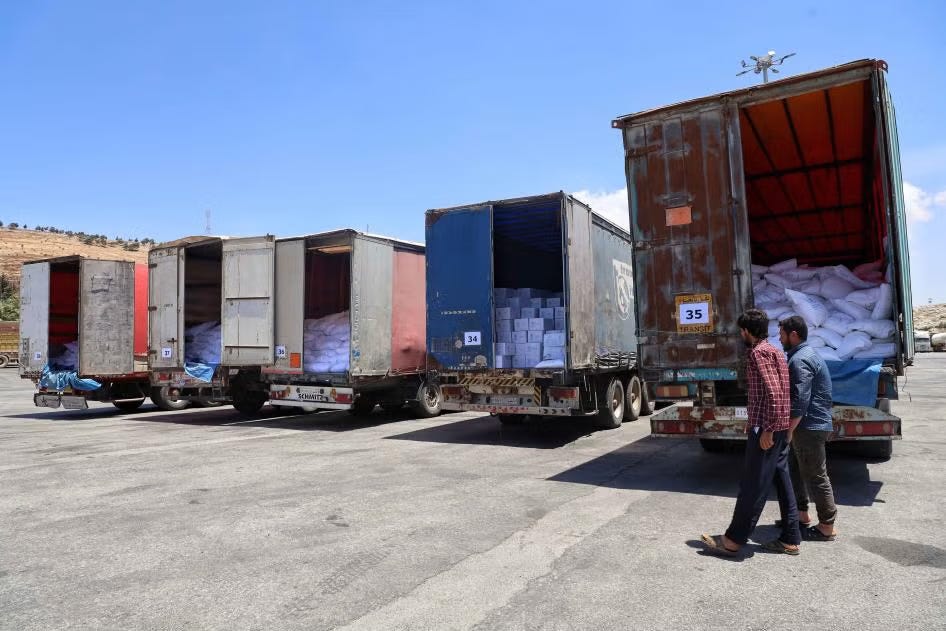
More troubling still, the humanitarian track did not remain a complement to the political process. It gradually displaced it. The center of international debate shifted from how to create a safe and neutral environment in which political transition could occur, refugees and displaced people could return, and Syrians could shape their country’s future, to the logistics of aid delivery: Should assistance cross international borders or front lines? Who should authorize it? Who should monitor distribution? How long should the cross-border mechanism be renewed?
A safe environment no longer meant protection from bombardment and arbitrary detention, as well as bombings, indiscriminate shelling, abduction and revenge attacks. Nor did it mean economic security or a meaningful say in the country’s future. It came to mean a secure logistics corridor through which assistance could reach people even as they remained trapped in the political and security conditions that made them dependent on aid in the first place. Political rights became humanitarian needs; citizens became names on aid lists; and the question of power became a question of humanitarian access.
Griffiths was at the heart of this system, not an outside observer. That is why his reckoning feels so conspicuously incomplete. He acknowledges the failure of dialogue with al-Assad, but not the deeper transformation he witnessed: humanitarian relief displacing politics, and the consequences of violence being managed rather than the conditions that produced it being changed. More troubling still, he now comes close to proposing another substitution of the same kind. Having allowed aid to replace political transition, the international community is now invited to let investment replace the rebuilding of the state.
Protecting investors, but what about citizens?
To be fair, Griffiths does not ignore Syria’s authorities. He calls on them to act publicly, inclusively and decisively, and to create an investment-friendly environment through carefully considered legislation rather than decrees and promises. Yet his recommendations all serve one central objective: reassuring capital. The legislation he seeks is legislation that makes investment possible, while inclusion appears primarily as a means of improving the authorities’ capacity to deliver. The safeguards Syrians need as citizens—not merely as aid recipients or workers on reconstruction sites—receive no comparable attention.
Capital does indeed require predictable rules and legal protection. So do citizens. They need an independent judiciary, secure property rights, accountable administration, the right to challenge official decisions, meaningful political participation and access to legal redress.
Reconstruction is not a politically neutral technical exercise. It determines who owns the land, who wins the contracts, who is able to return, who is excluded, and how wealth and influence are redistributed. Without oversight and transparency, reconstruction can cease to be a vehicle for social recovery and become instead a redistribution of the state itself among the victors and their partners.
It is not enough, then, to make Syria safe for capital. The prior question is whether the state has become safe for its citizens.
Giving the authorities greater economic power and a stronger capacity to impose order, without addressing the crisis of legitimacy or building safeguards around the use of force and public resources, may produce a fragile stability: lower levels of violence while the causes of conflict remain intact beneath the surface, alongside a greater ability to close political space and entrench existing inequalities. A dominant authority can impose calm; only public consent to the rules of the state can sustain peace.
The alternative: tie economic recovery to legitimacy
The answer is not to hold reconstruction hostage to an ideal political transition. Nor is it to retain sanctions that have burdened Syrians, deepened the collapse and obstructed recovery, or preserve a war economy whose spoils have been shared by networks connected to every side of the conflict while civilians are left with poverty and dependence on aid.
Economic recovery and political reconstruction must proceed together, so that economic progress reinforces state-building rather than replacing it. That requires transparency in major reconstruction contracts and independent scrutiny of their financing; protection of housing, land and property rights before—not after—the next wave of real-estate investment; a clearly defined transitional justice process that establishes the fate of the missing and detained and protects the rights of all victims, regardless of who committed the abuse; and international support tied to measurable progress on judicial independence and administrative accountability.
These are not unreasonable barriers to investment. They are the foundations of viable investment. Anyone investing in a country where property rights remain uncertain, and the courts are not independent, knows that they are buying access and influence, not secure assets.
Yet these safeguards cannot, by themselves, resolve the question of legitimacy. They can constrain how authority is exercised, but they cannot establish the authorities’ right to speak and act in the name of Syrians. Their purpose is to stop economics from closing the political question before it is even asked, and to prevent reconstruction from turning facts on the ground into a political settlement by default. Syrians should not discover years from now that public assets have been distributed and ownership settled before they were asked what kind of state they wanted. Only a political process can rebuild the relationship between state and society.
That is also the test facing the United Nations. In practice, it has moved from a political mediator that failed to secure a transition to a humanitarian manager of the consequences of violence. Its next role should not be to market stability and investment. It should use its leverage to ensure that reconstruction takes place within a political and institutional framework owned by Syrians.
The third failure
Griffiths’s headline says Syrians must not be failed again. A more honest reckoning is that they have already been failed twice. The first failure came when outside powers armed and managed the conflict without resolving it, then froze it without addressing its causes. The second came when politics was replaced by relief, keeping victims alive inside the very conditions that had produced their suffering.
A third failure would use investment to consolidate an authority that still lacks full legitimacy while once again postponing the question that has been deferred from the beginning: How do Syrians reclaim their state?
Griffiths reads the past as though military action saved Syria, and the future as though investment will complete the rescue. But military action toppled the regime without rebuilding the state. Investment may consolidate authority without creating legitimacy.
If money begins to flow and those in power become more secure, while Syrians remain shut out of their state and the roots of conflict lie dormant beneath the surface, will Martin Griffiths return years from now with another reckoning—acknowledging that the international community financed the status quo before building peace, and urging the world, this time, not to fail Syrians for a third time?